

A SWIFT payment’s final cost equals your bank’s outgoing fee, plus intermediary correspondent fees, plus the FX spread, plus any receiving bank fee. Intermediary deductions make the amount that actually lands unpredictable unless you take control of it. The fix is straightforward: instruct OUR when the exact amount matters, request SWIFT gpi tracking with a UETR, and where possible, work with a payment partner that holds direct correspondent relationships instead of routing through several unrelated banks.
TL;DR:
- Correspondent bank fees and FX spreads often cause the largest and least visible costs, typically adding up to around 6% for small transfers and over 2% for large ones.
- Choosing the correct charge instruction, such as OUR, can ensure the recipient gets the full amount, but some banks still apply fees regardless of your selection.
- Tracking payments with SWIFT gpi and calculating total landed costs beforehand can significantly reduce surprises and hidden deductions.
- Consolidating smaller payments and working with providers with direct correspondent links lowers fees and improves predictability.
- Most advice focuses on the sender’s fee and ignores the dominant costs from intermediary deductions and currency markup, which are crucial for accurate cost control.
Table of Contents
- Breaking Down SWIFT Payment Charges: Sender, Correspondent, FX, and Receiver
- How Much Do SWIFT Fees Really Add Up To?
- OUR, SHA, or BEN: Who Pays the Correspondent Fees?
- Practical Ways to Cut SWIFT Costs and Avoid Surprise Deductions
- How Demivolt Approaches SWIFT Payment Transparency
- What Most Advice on SWIFT Fees Gets Wrong
- A More Predictable Way to Send International Payments
- Sources
Breaking Down SWIFT Payment Charges: Sender, Correspondent, FX, and Receiver
Every SWIFT transfer carries up to four separate charges, and most bank statements only show you one of them clearly. Understanding SWIFT charges means learning to spot all four, because the ones you don’t see are usually the ones that cost the most.
- Sender (outgoing) fee. This is the line item your own bank shows on the debit confirmation, billed either as a flat charge or a small percentage of the transfer amount. It sits at the front of the transaction and is the easiest fee to negotiate.
- Correspondent (intermediary) fees. SWIFT is a messaging network, not a payment rail. Your bank and the recipient’s bank don’t always hold a direct account relationship, so the payment hops through one or more correspondent banks that each take a service charge before passing the funds along, a structure confirmed in SWIFT’s own payment processing framework. The number of hops, and therefore the total deducted, varies by currency corridor and by which banks are involved.
- FX spread. When the payment converts currency, the bank applies a markup over the mid-market rate rather than charging that markup as a visible fee.
- Receiving (beneficiary) fee. Some banks charge the recipient simply for crediting an inbound SWIFT payment, even when nothing was wrong with the transfer.
The sender fee is visible and negotiable. The other three usually aren’t, unless you ask for a full breakdown in advance.
How Much Do SWIFT Fees Really Add Up To?
Numbers make this concrete. Outgoing SWIFT fees at Lithuanian-linked entities are charged by banks and may vary, often including a fixed component plus a percentage of the amount, according to Lietuvos bankas’ published fee data. Correspondent banks generally charge a service fee per hop, varying by institution and payment corridor, and a payment can pass through one, two, or occasionally three of them depending on the currency pair. Bank price lists such as Luminor’s SWIFT service pricing show these charges broken into monthly administration fees and per-message costs, which is worth checking before you assume a single flat rate applies.
Here’s how the math plays out on two common payment sizes:
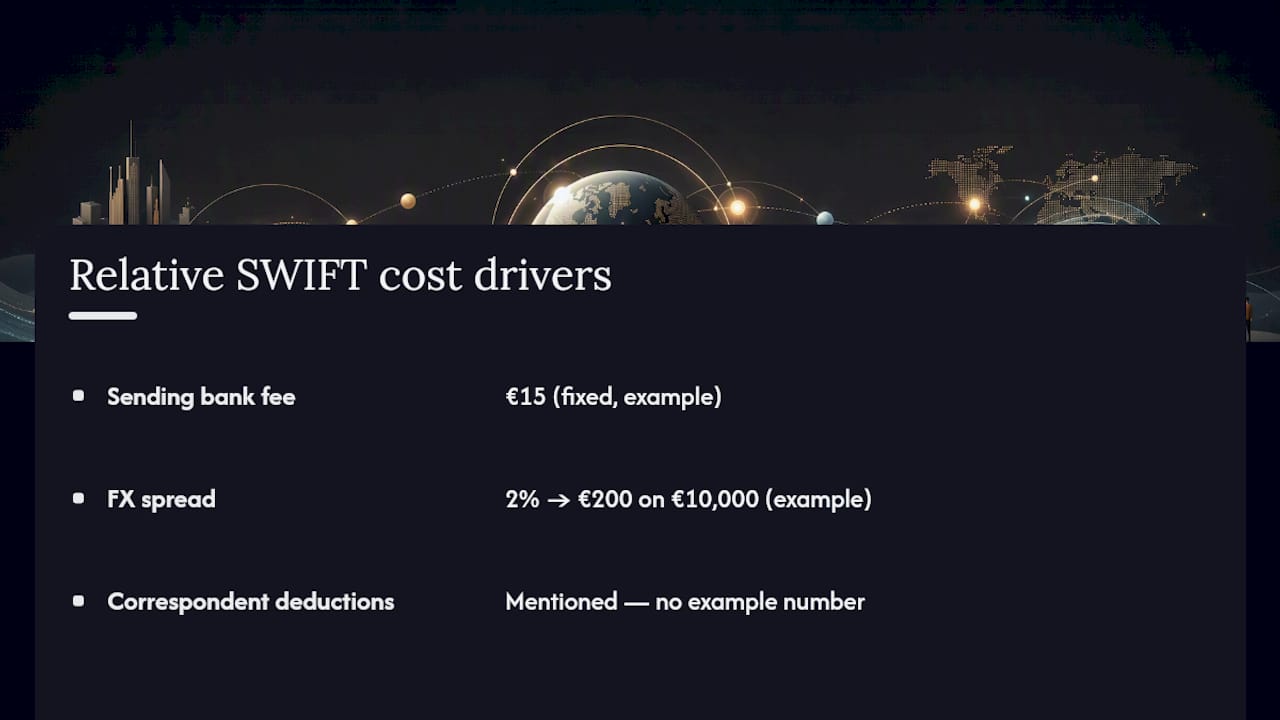
- A €1,000 payment with a €15 sending fee, one correspondent hop at €25, and a 2% FX spread loses about €60 to €65 in total, roughly 6% of the transfer.
- A €10,000 payment with the same €15 sending fee and one €25 correspondent hop, but the same 2% FX spread, loses closer to €240, and the FX spread alone now accounts for the overwhelming majority of that cost.
FX spread is frequently the single largest cost in a SWIFT payment, often running between 1.5% and 3% on major currency corridors, a pattern documented across SWIFT’s own analysis of gpi and payment processing costs. A flat €25 correspondent fee looks alarming on a small transfer. On a large one, it’s the exchange rate markup quietly doing the damage.
OUR, SHA, or BEN: Who Pays the Correspondent Fees?
The charge instruction you select on a SWIFT payment determines who absorbs those correspondent deductions, and picking the wrong one is how businesses end up shortchanging suppliers without meaning to.
- OUR means the sender pays every fee, including correspondent deductions, so the beneficiary receives the full invoiced amount.
- SHA (shared) means the sender pays their own bank’s fee, while correspondent and receiving fees come out of the amount before it reaches the beneficiary.
- BEN means the beneficiary absorbs all fees, including the sender’s own bank charge, deducted from the transfer.
EEA-based payment institutions frequently cannot offer OUR at all for EEA-to-EEA corporate payments. PSD2 transparency rules push many providers to default to SHA in that scenario, a constraint outlined in Currencycloud’s charge rules documentation. For payments outside the EEA, OUR is usually still available, just at a higher sending cost.
Pro Tip: If your supplier’s invoice states a net amount that must arrive in full, instruct OUR and confirm it in writing with your bank before sending. Otherwise, SHA is usually the cheaper default, but tell your payee in advance that a small deduction may appear on their end.

One operational wrinkle worth flagging: even with OUR selected, some receiving banks still apply their own crediting fee regardless of your instruction.
Practical Ways to Cut SWIFT Costs and Avoid Surprise Deductions
Lowering the total cost of a SWIFT payment comes down to a handful of concrete moves, not a single silver bullet.
- Request gpi tracking and record the UETR. SWIFT gpi assigns a Unique End-to-end Transaction Reference that follows the payment through every correspondent hop, which is the fastest way to trace a delayed or short-landed transfer, according to SWIFT’s gpi documentation. Log the UETR in your accounting or treasury system the moment you send.
- Calculate the landed cost before you choose a rail. Add the outgoing fee, expected correspondent deductions, FX markup, and likely receiving fee together, rather than comparing sending fees alone.
- Consolidate smaller payments. SWIFT’s fixed costs make frequent low-value transfers inefficient; batching payments to the same supplier, or shifting them to SEPA where the corridor allows it, amortizes those fixed fees across a larger amount.
- Work with providers that hold direct correspondent links. Fewer hops generally means fewer deductions and more predictable delivery.
- Negotiate your business banking fees, and initiate online where you can. Wire fees often run lower through online initiation than in-branch, a pattern Bankrate’s research on wire transfer fees confirms across account tiers.
Pro Tip: Ask your bank for a full fee breakdown, sending fee, expected correspondent range, FX margin, before you send a large payment. Most banks will give you this in writing if you ask directly, and it turns guesswork into an actual comparison.
How Demivolt Approaches SWIFT Payment Transparency
Demivolt operates as a regulated European fintech offering dedicated IBAN accounts, SEPA and SWIFT payment processing, and multi-account structures built for businesses that move money across borders regularly. Client funds sit in segregated accounts, and onboarding is designed to be fast without cutting corners on compliance.
For SWIFT payments specifically, that translates into a few concrete controls:
- Transparent fee disclosure before a payment is sent, so the sending fee is never a surprise on the statement.
- Support for gpi-style tracking visibility, giving finance teams a way to follow a payment through the correspondent chain.
- Routing built around minimizing unnecessary hops where the underlying corridor allows it.
Readers who want the mechanics behind this can go deeper in Demivolt’s guide to SWIFT payments for businesses, which covers the 2025 to 2026 shift toward ISO 20022 messaging in more technical detail.
What Most Advice on SWIFT Fees Gets Wrong
Most guidance on this topic fixates on the sending bank’s fee, the one number printed clearly on your debit confirmation, while ignoring the two costs that actually decide how much money arrives: correspondent deductions and FX spread. That’s backward. A €15 sending fee is trivial next to a 2% currency markup on a €10,000 invoice payment, and treating the sending fee as “the cost” leads finance teams to negotiate the wrong line item.
The instruction to “just pick OUR” is also incomplete advice. PSD2 rules mean many EEA payment institutions cannot offer it for EEA-to-EEA flows in the first place, so the real skill isn’t picking OUR reflexively. It’s knowing when the option exists, when SHA is unavoidable, and communicating that to your payee either way.
If you take one thing from this: model the FX spread as a percentage in your supplier contracts and treasury forecasts, not as an afterthought line item. That single habit catches more unexpected cost than any amount of fee-schedule shopping.
— dd
A More Predictable Way to Send International Payments
Demivolt gives Lithuanian businesses a way to send SWIFT payments without guessing what the recipient will actually receive. Instead of piecing together fee schedules from multiple banks, you get one regulated account with disclosed sending costs and gpi-style tracking visibility built into how payments move, so the FX spread and correspondent deductions stop being a surprise on the other end.
For businesses still weighing whether a payment should go through SWIFT or SEPA in the first place, Demivolt’s SEPA vs SWIFT explainer breaks down which rail actually fits your corridor and payment size. If you’re ready to see how a dedicated IBAN account and transparent SWIFT pricing would work for your business, you can start by opening a Demivolt account and reviewing your first fee breakdown directly.