

TL;DR:
- European SMEs face higher costs and delays using outdated payment rails like SWIFT instead of SEPA Instant.
- Implementing multi-rail, compliant payment solutions, including fintech platforms and stablecoins, can significantly reduce fees and processing time.
- Continuous review and optimization of payment infrastructure are essential for growth, compliance, and improved customer experience.
For European SMEs, the difference between a SEPA Instant transfer and a SWIFT wire is not just a matter of speed. It is a matter of cost, compliance, and sometimes whether you keep a customer at all. The B2B cross-border market is projected to reach €35 trillion by 2028, yet SMEs regularly pay up to 10x more per transaction than larger enterprises simply because they default to familiar but outdated payment rails. This guide cuts through that confusion. We cover the core types of business payment solutions available in Europe, how they work, what they cost, and how to put together a smarter setup that supports growth and stays fully compliant.
Table of Contents
- What are business payment solutions in Europe?
- Key mechanics: How payments flow, settle, and clear
- Cost, speed, and risk: Traditional banks vs fintechs and new rails
- Practical steps: Implementing and optimizing payment solutions
- A fresh perspective: Why payment optimization is strategic, not tactical
- Discover how Demivolt can simplify payments for your business
- Frequently asked questions
Key Takeaways
| Point | Details |
|---|---|
| Payment choices matter | The right payment solution saves significant costs, speeds up settlements, and ensures compliance for cross-border SME operations. |
| SEPA and fintechs dominate | SEPA Instant and fintech providers offer fast, affordable payments, outpacing traditional banks in most European use cases. |
| Local methods boost conversion | Integrating local payment options like iDEAL or Bancontact can dramatically increase customer checkout success in key EU markets. |
| Optimization is ongoing | Regularly reviewing and updating payment solutions is essential for keeping up with regulation, costs, and customer preferences. |
What are business payment solutions in Europe?
The term “business payment solutions” covers a wide spectrum. At its core, it refers to the infrastructure and services that allow a company to send and receive money, whether from customers, suppliers, or partners. Most European SMEs interact with three main categories: payment gateways, payment processors, and merchant accounts. A gateway collects and transmits payment data. A processor handles the actual movement of funds. A merchant account holds those funds temporarily before they settle into your business bank account.
In practice, the European payment landscape layers several distinct payment types on top of this infrastructure, each suited to specific use cases:
- Card payments (Visa, Mastercard): Fast, familiar, but carry interchange fees of 0.2 to 1.5% depending on card type and merchant category
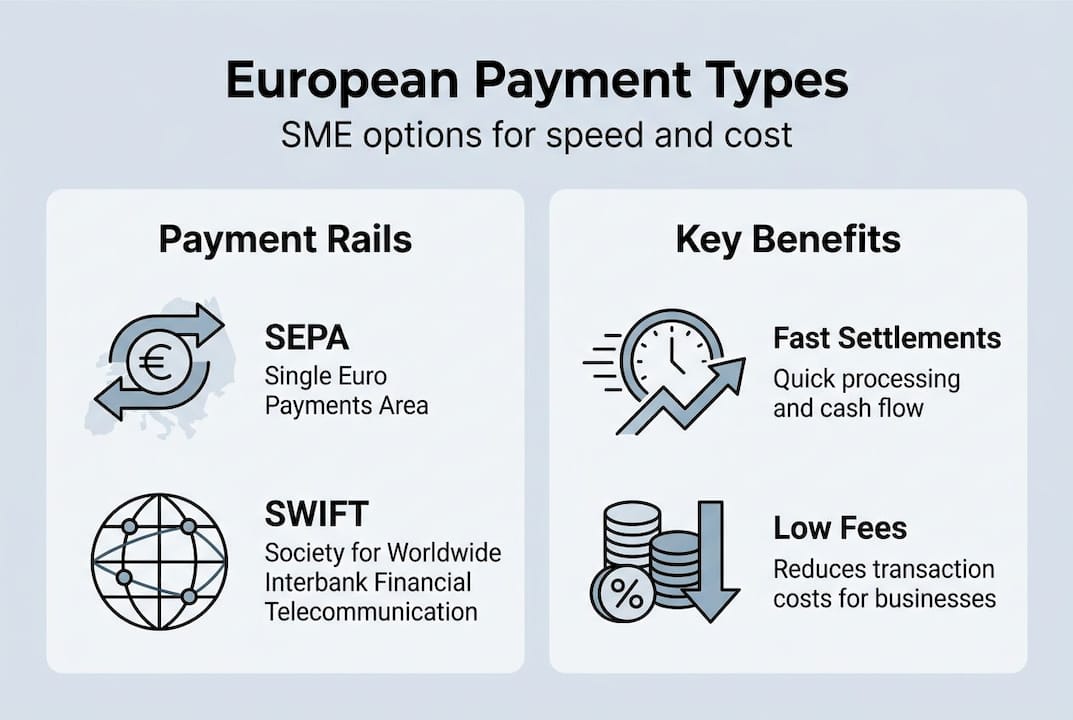
- SEPA Credit Transfer (SCT): Bank-to-bank transfer within the SEPA zone, typically settling in one business day
- SEPA Instant Credit Transfer (SCT Inst): The same rail but processed in under 10 seconds, available 24/7
- SEPA Direct Debit (SDD): Pull-based payment where you collect funds from a customer’s account, popular for subscriptions
- Alternative Payment Methods (APMs): Country-specific options like iDEAL in the Netherlands, Bancontact in Belgium, and Sofort in Germany
| Payment type | Coverage | Typical settlement | Best use case |
|---|---|---|---|
| Card (Visa/MC) | Global | 1-3 days | Customer checkout |
| SEPA Credit Transfer | 36 countries | 1 business day | B2B invoices |
| SEPA Instant | 36 countries | Under 10 seconds | Urgent payouts |
| SEPA Direct Debit | 36 countries | 2-5 days | Subscriptions |
| APMs (iDEAL, etc.) | Country-specific | Varies | Local markets |
Compliance sits underneath all of it. PCI DSS (Payment Card Industry Data Security Standard) governs how card data is stored and transmitted. PSD2 and Strong Customer Authentication (SCA) require multi-factor verification for most online card payments within the EU. Both are non-negotiable. A solid business banking overview will tell you the same thing: getting the compliance layer right from day one is far cheaper than fixing it later.
Key mechanics: How payments flow, settle, and clear
Understanding the journey a payment takes from click to cleared funds helps you spot where delays and costs pile up. Here is the basic sequence for an online card payment:
- Authorization: The customer submits payment details; the gateway requests approval from the issuing bank
- Authentication (SCA): Under PSD2, the customer confirms identity via a second factor, such as a banking app push notification or one-time code
- Capture: The authorized amount is locked and queued for collection
- Settlement: Funds move from the customer’s bank to your processor or merchant account
- Payout: Your processor releases cleared funds to your business bank account
Each step adds time. Authentication in particular creates friction. Failed or abandoned SCA challenges can drop conversion rates by 10 to 20%, which is a serious problem for high-volume digital businesses.
Now compare the main payment rails side by side:
| Rail | Speed | Typical fee | Coverage |
|---|---|---|---|
| SEPA Credit Transfer | 1 business day | Low (flat fee) | 36 SEPA countries |
| SEPA Instant | Under 10 seconds | Slightly higher | 36 SEPA countries |
| SEPA Direct Debit | 2-5 business days | Low | 36 SEPA countries |
| SWIFT | 1-5 business days | High (€25-50 + FX) | Global |
Alternative method gateways like Stripe, Mollie, and PayPal sit on top of these rails and give you a single API to handle multiple payment types. That matters if you sell across borders, because a Dutch customer who does not see iDEAL at checkout is very likely to abandon. Knowing how to open a business bank account with IBAN infrastructure that connects cleanly to these gateways is a foundational step.

For intra-EU payouts, review your SWIFT payment guide before defaulting to wire transfers. SWIFT remains valuable for global reach, but the cost and timeline disadvantages are substantial inside Europe.
Pro Tip: The EU’s 2025 SEPA Instant mandate means banks and payment service providers are now required to offer SCT Inst at no premium over standard SEPA transfers. If your provider still charges extra for instant payments, it is worth pushing back or switching.
Cost, speed, and risk: Traditional banks vs fintechs and new rails
Most SMEs start with their incumbent business bank for payments. Reliable, yes. But the cost structure is rarely designed with cross-border efficiency in mind. Traditional banks typically apply FX markups of 2 to 5% on top of wire fees of €25 to €50 per outgoing international transfer. Fintech platforms, by contrast, commonly offer FX markups of 0.3 to 0.7% with much lower or flat-rate transfer fees. Stablecoins like USDC can reduce fees by up to 40% compared to conventional payment rails.
“Businesses that switch to local payment methods and fintech rails consistently report significant savings. One European fashion retailer saved €100,000 per year by replacing SWIFT with local methods, and stablecoin-based B2B transfers are delivering similar results for international suppliers.”
Here is how the main options break down in practice:
- Traditional banks: High reliability and regulatory trust, but slow FX processing, opaque fee structures, and limited API access for automation. Best for large, infrequent B2B transfers where relationship banking matters.
- Fintechs (Wise, Revolut Business, Mollie): Lower fees, better FX rates, access to local APMs, fast onboarding. The trade-off is sometimes less direct control over dispute resolution and tighter limits on high-value transfers. Explore fintech cross-border payment advantages in detail before committing.
- Stablecoins (USDC, EURC): Near-instant settlement, very low transaction fees. The real challenge is accounting and tax treatment. Most European jurisdictions require you to track the EUR-equivalent value at the time of each transaction, which adds bookkeeping complexity.
- APMs via gateway aggregators: Essential for conversion in specific markets. Missing iDEAL in the Netherlands or Bancontact in Belgium is a direct revenue leak.
Key risks to factor into any decision:
- Compliance gaps: An unlicensed provider exposes you to regulatory risk
- Failed SCA flows: Poor authentication UX kills conversions silently
- High-risk merchant categories: Certain industries face higher processing fees or outright rejection by mainstream processors
For a broader look at your options, the guide on international payment strategies covers how to structure multi-rail payment setups that balance cost and resilience.
Practical steps: Implementing and optimizing payment solutions
Choosing a payment solution is not a one-time decision. The businesses that get this right treat it as an ongoing process with regular review cycles. Start with a clear decision framework before evaluating any provider.
Step 1: Map your customer markets. Where do your customers and suppliers actually sit? A business with 60% of revenue from the Netherlands needs iDEAL. One serving UK clients post-Brexit needs to account for non-SEPA transfer costs.
Step 2: Audit your compliance obligations. PCI DSS scope depends on how you handle card data. Hosted payment pages (where the gateway collects card data on its own servers) dramatically reduce your PCI burden. Local APMs via gateways like Mollie or Stripe and SEPA Instant for payouts are the recommended starting point for digital-first SMEs.
Step 3: Evaluate providers on settlement speed and payout terms. A gateway with a 7-day payout delay can create serious cash flow problems for SMEs with thin working capital.
Step 4: Test your SCA implementation before go-live. Run conversion tests across different devices and banks. SCA failure rates vary significantly by issuer, so baseline data from your own traffic is essential.
Step 5: Implement PCI and SCA compliance monitoring. This is not a set-and-forget task. Processors update their SCA exemption rules, and regulators revise thresholds. Assign someone to review quarterly.
Pro Tip: Track your DSO (days sales outstanding) alongside your failed SCA rate every month. A rising DSO often signals a settlement delay or high dispute rate that your provider dashboard does not surface clearly. Catching it early saves you from cash flow shortfalls that compound quickly.
Continuous optimization also means staying current with regulation. Review fee structures with your provider at least annually. Keep an eye on modern banking trends around open banking and instant payment mandates. And if you are curious about where things are heading, stablecoin payment integration is becoming a real operational option rather than a niche experiment.
A fresh perspective: Why payment optimization is strategic, not tactical
Most businesses treat payment setup as an admin task. You pick a processor, add a checkout, and move on. That mindset is expensive in 2026.
We have seen businesses lose meaningful international revenue not because their product was wrong, but because their checkout did not support the payment method a customer expected, or their SWIFT transfer took four days when a competitor using SEPA Instant settled the same deal overnight. Payment flow is a growth lever. The businesses that find the right business account structure, iterate on their payment rails, and actively monitor conversion and cost metrics retain more international customers and access new markets faster.
The regulatory and technology landscape in Europe is also moving fast. SEPA Instant mandates, open banking API adoption, and the EU’s Digital Euro project will all reshape what “standard” business payments look like within the next two years. Static payment setups will quietly erode conversion and margin. The SMEs that treat this as an active operational priority will compound the savings and customer trust advantages year over year.
Discover how Demivolt can simplify payments for your business
Everything covered in this guide points to the same need: a payment infrastructure that is fast, compliant, and built for cross-border operations. That is exactly what Demivolt is designed to deliver.
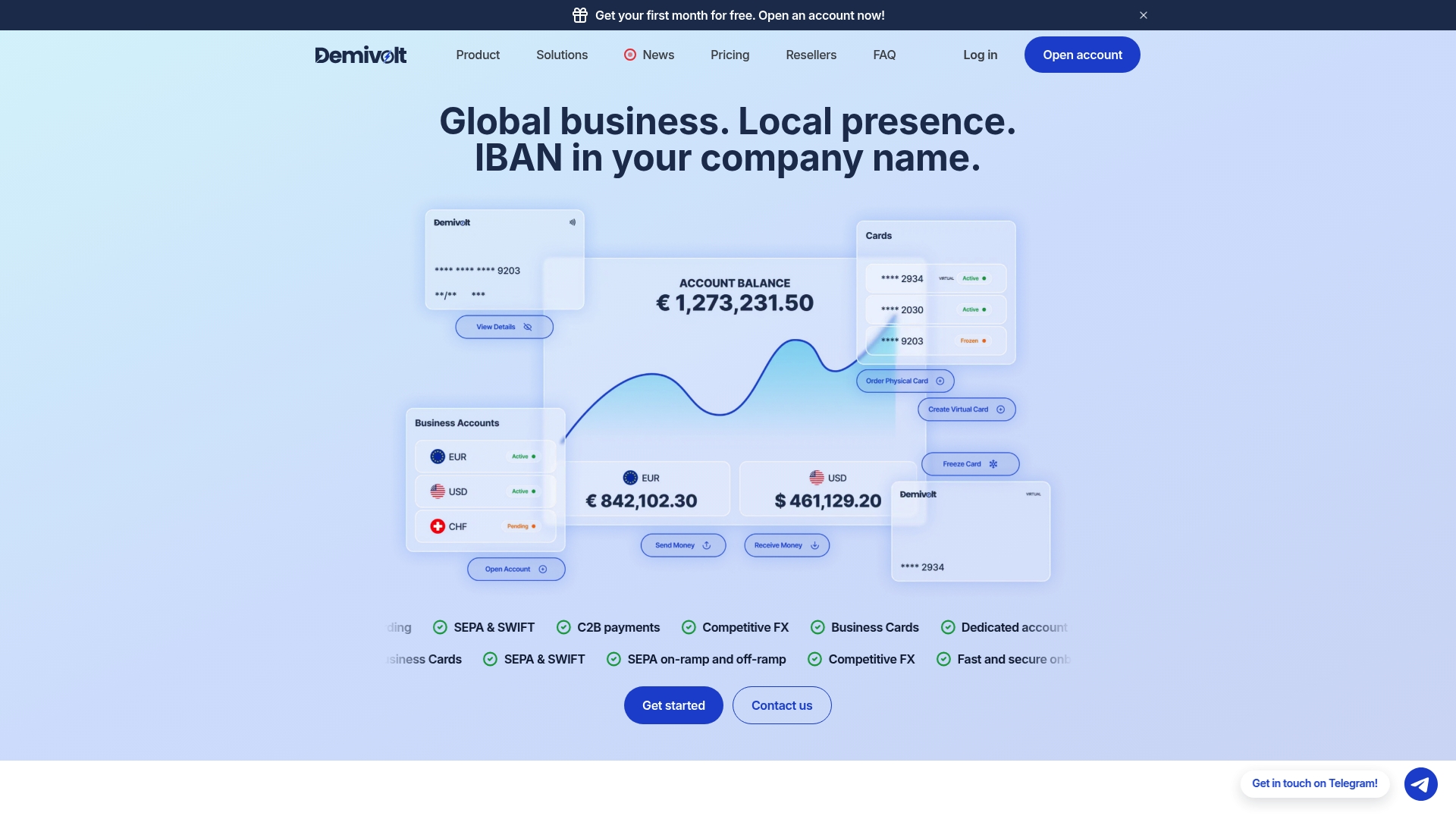
Demivolt gives European SMEs dedicated IBAN accounts, full SEPA and SWIFT payment management, and virtual and physical business cards, all within a regulated, EU-compliant platform. Onboarding is fast and transparent, and your funds are held in segregated accounts for full security. Whether you are managing multi-currency payouts, integrating with external banking systems, or looking for a cleaner compliance setup, Demivolt provides the infrastructure to move with confidence. Reach out today to explore how we can support your payment operations.
Frequently asked questions
What is the fastest way for businesses to send money across Europe?
SEPA Instant transfer is the fastest option, clearing payments in under 10 seconds across 36 countries, 24 hours a day, 7 days a week.
How much can SMEs save by using fintechs over banks for payments?
SMEs can save 80 to 95% on fees by using fintech platforms instead of traditional banks, primarily through lower FX markups and reduced transfer charges.
What compliance issues do European businesses face with cross-border payments?
Businessers must comply with PCI DSS and PSD2/SCA requirements, covering card data security and mandatory Strong Customer Authentication for online transactions within the EU.
What are the main risks of using stablecoins for business payments?
Stablecoins offer speed and lower fees, but introduce tax and accounting complexity because each transaction requires tracking the EUR-equivalent value at time of settlement.
How can SMEs reduce abandoned payments during checkout?
Integrating local payment methods and properly optimizing SCA authentication flows can reduce checkout abandonment by 10 to 20%, particularly for customers on mobile devices or unfamiliar banks.
Recommended
- Demivolt | Blog – Business banking for SMEs: services, compliance & cross-border
- Demivolt | Blog – Open a business bank account online in Europe: step-by-step
- Demivolt | Blog – Types of Business Bank Accounts: Find the Right Fit for Your SME
- Demivolt | Blog – International payments for SMEs: efficiency, compliance, growth