

TL;DR:
- Payment compliance involves following laws and standards that protect payment data and ensure security.
- Businesses must continuously monitor and document their compliance to meet evolving regulations and avoid penalties.
Payment compliance is defined as the practice of meeting all laws, regulations, and internal standards that govern how businesses process financial transactions and protect payment data. Regulatory bodies including the PCI Security Standards Council, FinCEN, the CFPB, and GDPR enforcement authorities each impose distinct obligations on businesses that handle money. Failing to meet those obligations carries real consequences: fines, fraud exposure, and loss of customer trust. This guide breaks down the core frameworks, operational impacts, common pitfalls, and best practices you need to run a compliant payment operation in 2026.
What is payment compliance and which regulations govern it?
Payment compliance is the industry term for a business’s adherence to the full set of rules covering payment security, data privacy, anti-money laundering, and consumer protection. No single law covers everything. Instead, multiple frameworks apply simultaneously, and your specific obligations depend on where you operate, what payment methods you accept, and whether you hold or transmit customer funds.

PCI DSS 4.0.1 is the baseline standard for any business that accepts, stores, or transmits card data. PCI DSS 4.0.1 became mandatory on March 31, 2025, with monthly fines ranging from $5,000 to $100,000 for violations. That fine range means a single year of non-compliance can cost a mid-sized business over $1 million before any breach-related losses are counted.
AML and KYC obligations apply under the Bank Secrecy Act (BSA) and FinCEN rules. Payment processors must register as Money Services Businesses (MSBs) if they hold or transmit customer funds, regardless of company size. MSB registration triggers ongoing customer due diligence, transaction monitoring, and suspicious activity reporting requirements.
PSD2 and Strong Customer Authentication (SCA) govern EU and EEA transactions. PSD2 mandates SCA for electronic transactions over €30, typically implemented through 3D Secure 2.0. Skipping SCA does not just create a compliance gap. It causes issuer banks to decline the transaction outright.
GDPR adds a data privacy layer on top of payment security. Businesses face fines up to €20 million or 4% of global annual turnover for mishandling payment data under GDPR. Meta received a €405 million GDPR fine in 2022, which illustrates that regulators treat payment data breaches as serious enforcement priorities.
U.S. state money transmitter licensing creates another layer of complexity. Money transmitter licenses are required in more than 40 U.S. states for businesses that hold or move customer funds. Federal penalties for operating without proper registration include imprisonment, making this one of the most underestimated requirements for growing businesses.
How do payment compliance requirements affect daily operations?
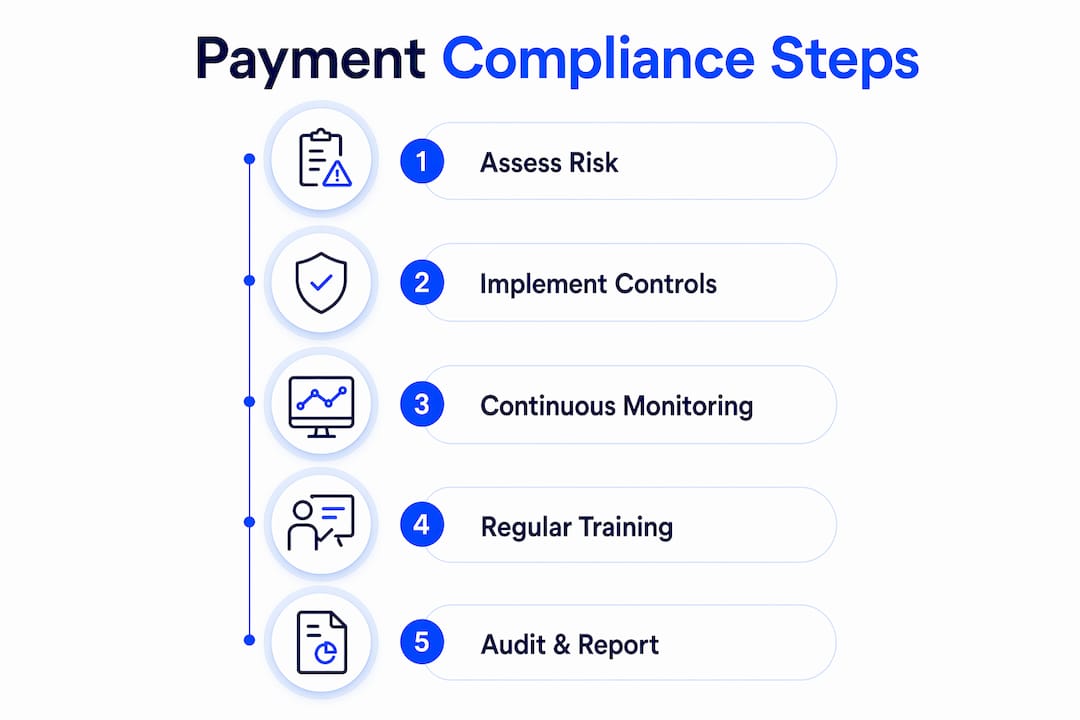
Payment compliance is not a one-time setup task. Compliance is a continuous process requiring ongoing monitoring, regular audits, and a documented Compliance Management System (CMS) with clearly defined policies and escalation procedures. Regulators assess operational maturity by reviewing your CMS documentation, not just your technical controls.
The practical impact shows up across several operational areas:
- Risk assessment before product launches. Formal risk assessments before launching payment products allow businesses to prioritize compliance resources effectively. Without this step, teams often spread effort across every possible risk and address none of them well.
- PCI scope management. Directly handling raw cardholder data significantly increases PCI DSS burden. Using hosted payment forms or iFrames reduces your scope to a simpler SAQ A self-assessment, cutting both cost and audit complexity.
- Vendor due diligence. Third-party vendors account for 43% of payment processing compliance failures according to a 2024 report. Every payment processor, gateway, and data sub-processor you work with must be assessed for their own compliance certifications and data handling practices.
- Incident response planning. PCI DSS and GDPR both require breach notification within 72 hours, to card brands and banks under PCI, and to supervisory authorities under GDPR. A response plan that has never been tested will almost certainly fail under that time pressure.
Pro Tip: Assign a named compliance owner for each regulatory framework your business falls under. When PCI, AML, and GDPR responsibilities all sit with “the team,” nothing gets done consistently.
What are common payment compliance pitfalls to avoid?
Most compliance failures are predictable. The same mistakes appear across businesses of every size, and understanding them in advance is the most cost-effective form of risk management.
- Handling card data directly. Storing or processing raw card numbers in your own systems puts you in the highest PCI DSS scope tier. The audit cost and technical burden of that tier is avoidable for most businesses through hosted payment solutions.
- Underestimating AML obligations. Many businesses assume AML rules only apply to banks. AML programs for payment companies must include customer due diligence, transaction monitoring, and suspicious activity reporting. Acting as a payment facilitator or holding customer funds triggers these obligations regardless of your primary business model.
- Weak merchant risk profiling. Accepting payments from high-risk merchants without adequate screening creates AML exposure. Sanctions list screening must happen automatically and at scale, not manually on a case-by-case basis.
- Ignoring regulatory evolution. PSD3 is in development and will expand liability for service providers. Businesses that treat compliance as a fixed checklist get caught off guard when regulations update.
- Overlooking state licensing. A business that complies perfectly with federal AML rules but skips state money transmitter licensing in even one state faces criminal exposure. This is especially common among startups that expand geographically without updating their licensing map.
- Untested incident response plans. Regulators require proof of governance including tested incident response plans. An untested plan is treated as no plan during an audit.
Pro Tip: Review your compliance obligations every time you add a new payment method, enter a new market, or change your banking or processing relationships. Each change can shift your regulatory category.
For businesses operating across borders, a structured international payment compliance checklist helps map obligations by jurisdiction before they become enforcement problems.
What best practices help businesses maintain payment compliance?
Building a payment compliance program that holds up over time requires structure, not just intent. The following practices form the foundation of a program that regulators and auditors recognize as mature.
- Build a risk-based compliance playbook. Cover PCI DSS, AML/KYC, PSD2/SCA, and GDPR in a single documented framework. Assign ownership, set review cycles, and define escalation paths for each area.
- Reduce PCI scope through architecture choices. Use hosted payment pages or iFrames so card data never touches your servers. This moves you to SAQ A, the simplest PCI self-assessment category, and dramatically reduces audit burden.
- Conduct systematic vendor assessments. Require compliance certifications from every third-party processor or data handler. Include contractual compliance obligations and audit rights in every vendor agreement.
- Enforce SCA for applicable transactions. Implement 3D Secure 2.0 for EU/EEA transactions over €30. For cross-border payment security practices, the international transfer security checklist from IdealRemit outlines the authentication steps that reduce both fraud and decline rates.
- Document everything. Policies, training records, audit logs, and incident response tests must all be written down and dated. Verbal processes do not satisfy regulators.
- Monitor continuously. Move away from annual reviews toward real-time transaction monitoring and automated alerts. Experts stress continuous monitoring over static checklists as the defining characteristic of mature compliance programs.
- Plan for market expansion. Each new country or payment method adds regulatory obligations. Map those obligations before launch, not after your first regulatory inquiry.
The EU payment regulations overview for 2026 covers GDPR and PSD2 requirements in detail for businesses processing payments across European markets.
Key Takeaways
Payment compliance requires simultaneous adherence to PCI DSS, AML/KYC, PSD2, and GDPR, and treating it as a continuous operational discipline rather than a one-time project is the only approach that holds up under regulatory scrutiny.
| Point | Details |
|---|---|
| PCI DSS 4.0.1 is mandatory | Monthly fines of $5,000–$100,000 apply to any business handling card data since march 31, 2025. |
| AML obligations apply broadly | Any business holding or transmitting customer funds must register as an MSB and run a full AML program. |
| Reduce PCI scope by design | Hosted payment forms limit your PCI scope to SAQ A, cutting audit cost and technical complexity. |
| Third-party risk is the top failure point | 43% of compliance failures trace to vendors; rigorous assessments and contractual obligations are required. |
| Continuous monitoring beats checklists | Regulators assess operational maturity through documented CMS and real-time monitoring, not annual reviews. |
Payment compliance as a competitive advantage, not a burden
I’ve worked with enough business owners to know that the word “compliance” triggers a specific reaction: eyes glaze over, someone mentions the legal team, and the conversation moves on. That reaction is expensive.
The businesses that treat payment compliance as a cost center tend to do the minimum. They check the boxes, file the paperwork, and then scramble when a regulation updates or an auditor asks for documentation that doesn’t exist. The businesses that treat compliance as an operational standard build something different. Their payment processes are cleaner, their vendor relationships are tighter, and their customers trust them with more transactions.
The most underrated benefit of strong compliance is market access. A business with documented AML controls, a tested incident response plan, and clear PCI scope management can enter new markets faster than one that has to rebuild its compliance posture from scratch for every jurisdiction. Compliance done right is not a gate. It’s a foundation.
My honest advice: stop treating compliance documentation as a regulatory obligation and start treating it as a living record of how your business handles money. When that documentation is accurate and current, it tells a story regulators and enterprise customers both want to hear.
— dd
How Demivolt supports your payment compliance program
Demivolt is built for businesses that take payment compliance seriously. The platform operates under EU regulatory standards, holds client funds in segregated accounts, and supports SEPA and SWIFT payments with the controls that cross-border compliance requires. For businesses verifying payment data accuracy, Demivolt’s free IBAN validator tool checks IBANs against the ISO 13616 standard before transfers are sent, reducing errors that create both operational and compliance problems. The full suite of free SEPA tools supports European payment standards across your operations. If you’re building or tightening your compliance program, Demivolt’s infrastructure gives you a regulated foundation to work from.
FAQ
What is payment compliance in simple terms?
Payment compliance is the practice of following all laws and standards that govern how your business processes payments and protects financial data. It covers card security, anti-money laundering, customer authentication, and data privacy.
What does PCI DSS require for businesses?
PCI DSS 4.0.1, mandatory since march 31, 2025, requires any business handling card data to meet specific security controls. Monthly fines for non-compliance range from $5,000 to $100,000 depending on violation severity.
When does a business need to register as a Money Services Business?
A business must register as an MSB with FinCEN if it holds or transmits customer funds, regardless of transaction volume or company size. This registration triggers AML program requirements including customer due diligence and suspicious activity reporting.
What is Strong Customer Authentication and who does it apply to?
Strong Customer Authentication (SCA) is a PSD2 requirement for EU and EEA electronic transactions over €30, typically implemented through 3D Secure 2.0. Businesses that skip SCA face issuer bank declines, not just regulatory penalties.
How often should businesses review their payment compliance program?
Payment compliance programs require continuous monitoring, not just annual reviews. Regulators assess maturity through documented CMS policies and real-time monitoring practices, and any change in payment methods or markets triggers an immediate compliance review.