

TL;DR:
- EU banking regulations form a complex, layered system of directives, regulations, and technical standards in flux, requiring proactive compliance management. Major frameworks like CRR III and CRD VI, scheduled for implementation in 2025 and 2026, set new capital and risk rules, with secondary legislation detailing operational specifics crucial for effective compliance. Understanding supervisory authorities and tracking evolving standards, especially secondary legislation, is vital for maintaining regulatory adherence across the EU’s harmonized yet diverse environment.
If you manage compliance or run a business in Europe, you already know that the EU banking regulations guide you need isn’t a single document. It’s a layered, fast-moving system of directives, regulations, supervisory mandates, and technical standards that is currently in the middle of several simultaneous overhauls. CRR III applies from January 2026, PSD3 just cleared final approval, and the EU AI Act is now actively reshaping governance requirements. If your compliance program still treats this as a static checklist, you’re already behind.
Table of Contents
- Key takeaways
- EU banking regulations guide: the foundational framework
- EU supervisory authorities: who regulates what
- Navigating secondary legislation and compliance challenges
- Recent regulatory trends shaping EU banking in 2026
- Practical steps for operational compliance
- My perspective: why compliance complexity is here to stay
- Simplify EU banking compliance with Demivolt
- FAQ
Key takeaways
| Point | Details |
|---|---|
| CRR III and CRD VI are live | These Basel III-implementing frameworks set new capital, risk, and governance rules in effect from early 2025 and 2026. |
| Supervisory bodies have distinct mandates | The ECB, EBA, ESMA, SRB, and AMLA each govern different aspects; knowing who regulates what saves time and prevents gaps. |
| Secondary legislation drives daily compliance | RTS and ITS are binding and contain the operational detail that primary regulations leave out. |
| PSD3 replaces PSD2 in 2027 | The new payment services framework approved in April 2026 will require significant operational updates by late 2027. |
| Soft law carries real compliance weight | ECB supervisory guidelines, Q&As, and SREP findings are not suggestions. Treat them as binding expectations. |
EU banking regulations guide: the foundational framework
EU banking law operates on two primary types of legislative instruments. Regulations are directly applicable in all member states the moment they enter into force. No national legislation required, no room for local interpretation. Directives, by contrast, set the outcome to achieve but leave each member state to pass its own implementing laws.
This distinction matters enormously in practice. CRR III and CRD VI sit on opposite sides of this divide. CRR III is a regulation: it applied directly from January 1, 2025, without any national transposition step. CRD VI is a directive: member states had until January 11, 2026, to transpose its capital, risk, and governance requirements into national law. Some missed that deadline, creating patchwork compliance exposure for cross-border institutions.
The major frameworks you need to understand are:
- CRR III / CRD VI: The EU implementation of Basel III finalization, covering capital adequacy, credit risk, operational risk, and governance
- PSD2 transitioning to PSD3: PSD3 was approved in April 2026, with implementation expected in late 2027, replacing both PSD2 and EMD2
- DORA (Digital Operational Resilience Act): Governs ICT risk management and incident reporting for financial entities
- EU AI Act: Entered into force on August 1, 2024, establishing a risk-tier framework with strict requirements for high-risk AI applications in financial services
Below primary law, binding secondary legislation fills in the operational specifics. Regulatory Technical Standards (RTS) tell you what requirements mean in practice. Implementing Technical Standards (ITS) tell you how to comply, including reporting formats. Both are published in the Official Journal and carry the same legal weight as the regulations they supplement.
Pro Tip: Before you build any compliance process around a directive, check whether your member state has fully transposed it and whether local law introduces additional requirements. CRD VI is a current example where national timelines diverged.
EU supervisory authorities: who regulates what
Understanding the EU banking oversight framework means knowing which body has authority over which type of institution and activity. Treating these agencies as interchangeable is a common and costly mistake.
| Authority | Primary mandate | Scope |
|---|---|---|
| ECB (via SSM) | Prudential supervision | Significant credit institutions in the eurozone |
| EBA | Regulatory harmonization and technical standards | All EU banks; drafts RTS and ITS |
| ESMA | Securities and market transparency | Capital markets, investment firms |
| SRB | Resolution and crisis management | Significant and cross-border banks |
| AMLA | Anti-money laundering supervision | Hybrid model; highest-risk financial entities |
The EU’s multilayered supervisory structure779859_EN.pdf) means these bodies frequently overlap. The ECB’s Single Supervisory Mechanism directly supervises roughly 113 significant institutions. For banks below that threshold, National Competent Authorities (NCAs) carry the supervisory load, though always within the EBA’s harmonized framework.
The EBA’s role is often underestimated. It doesn’t just observe. It drafts the binding technical standards that define what compliance looks like operationally across all member states. Its guidelines and Q&As, while technically non-binding on paper, function as supervisory expectations in every SREP cycle.
AMLA, the EU’s new Anti-Money Laundering Authority, adds another layer. Its hybrid supervision model means it directly oversees the highest-risk financial entities while coordinating with NCAs for the broader market. For compliance officers in fintech or payments, AMLA’s arrival in 2025 deserves dedicated attention.
Pro Tip: Monitor EBA’s consultation papers and final opinions, not just the finished technical standards. The reasoning in those documents often signals supervisory expectations that won’t appear in formal law for another 18 months.
Navigating secondary legislation and compliance challenges
Here is where many compliance programs fall short. The primary regulation sets the principle. The real operational requirements live in the RTS, ITS, guidelines, and Q&As that follow. Secondary legislation is the actual locus of compliance for day-to-day operations, and ignoring it is one of the most common and expensive mistakes in EU financial services.

Take DORA as an example. The regulation itself defines ICT risk management in broad terms. The accompanying RTS specifies exact incident classification thresholds, notification timelines, and testing requirements. A firm that read the regulation but skipped the RTS technical specifics built an entire incident management process that was technically non-compliant from day one.
Practical steps for managing secondary legislation effectively:
- Use CELEX numbers. CELEX identifiers are the only reliable way to track consolidated and amended versions of EU legal texts. Regulation names and popular titles get recycled or abbreviated inconsistently.
- Track EBA’s work program quarterly. New RTS and ITS are issued on a rolling basis. A quarterly review of EBA publications prevents compliance gaps from building silently.
- Monitor national transposition trackers. For directives like CRD VI and PSD3, each member state’s timeline and additional national requirements matter if you operate across borders.
- Treat supervisory guidelines as binding. NCAs expect full adherence to EBA guidelines during examinations. “It’s only guidance” is not a defensible position in a SREP review.
- Document your Level 2 and Level 3 mapping. Internal compliance matrices should explicitly show which RTS, ITS, and guidelines apply to each business process.
The SREP (Supervisory Review and Evaluation Process) run by the ECB is a dynamic supervisory tool, not a fixed checklist. It reflects evolving risk assessments and supervisory priorities. Institutions that wait for formal guidance before adjusting their risk posture consistently receive worse SREP outcomes.
Pro Tip: When EBA releases a Q&A response on a specific compliance scenario, flag it immediately. Those responses define how supervisors interpret ambiguous provisions and will appear in examination criteria.
Recent regulatory trends shaping EU banking in 2026
The direction of EU financial regulations has shifted meaningfully in the past two years. Four trends stand out for compliance officers.
-
Simplification as a stated priority. The European Banking Federation’s ‘Less is More’ report argues that excessive regulatory complexity is hurting EU competitiveness. The EU Commission has acknowledged this, and there is real momentum toward consolidating overlapping rules and reducing gold-plating at the national level.
-
Directives becoming regulations. The EU is deliberately converting directives into directly applicable regulations to reduce fragmentation. The ECB has emphasized that a genuine single rulebook requires harmonized rules, not 27 slightly different national versions of the same directive.
-
PSD3 and the Payment Services Regulation. The new payments framework goes significantly beyond PSD2. It covers open banking access rights, liability rules, strong customer authentication, and fraud liability. For businesses with payment products, the transition to PSD3 represents a substantive operational overhaul, not a cosmetic update.
-
EU AI Act compliance governance. Banks using AI in credit scoring, fraud detection, or customer onboarding likely fall within high-risk categories under the Act. That triggers requirements for human oversight, explainability, conformity assessments, and registration in the EU AI database. Ignoring AI compliance governance now means inheriting a much larger remediation project later.
“Deeper integration requires not just harmonized rules but a genuine simplification of the rule architecture. Complexity has become a competitive liability for European banking.” — ECB
Practical steps for operational compliance
Understanding the regulatory landscape matters. Translating it into daily operations is where compliance programs succeed or fail. Here is how to operationalize what this EU banking regulations guide covers.
Build a regulatory change management process. Assign ownership for tracking EBA, ECB, and AMLA publications. A reactive approach where compliance teams react to news headlines is not sufficient when binding technical standards can change reporting formats, capital calculations, or incident notification rules with 12 months’ notice.
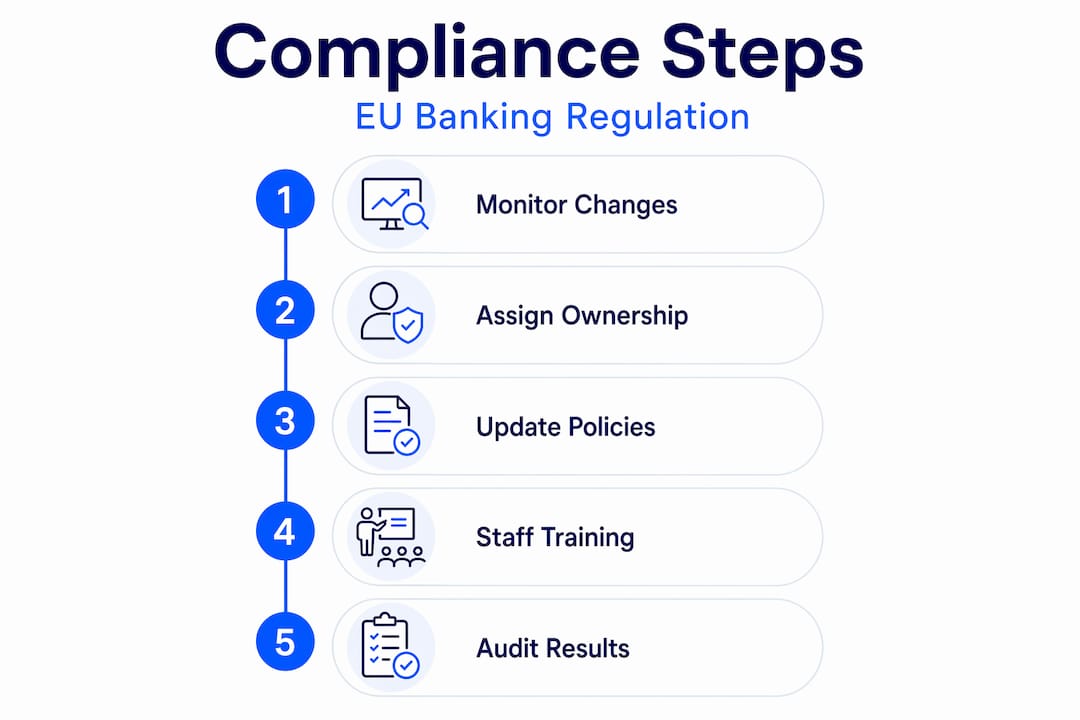
Map your reporting obligations to EBA’s technical packages. Reporting now centers on xBRL-CSV formats and metadata-driven submissions as of 2026. Firms that embedded these requirements into business-as-usual processes are consistently better positioned than those treating regulatory reporting as a parallel workstream.
Additional steps worth prioritizing:
- Align internal governance documentation with CRD VI’s updated requirements on fit-and-proper assessments and remuneration
- Conduct a gap analysis against DORA RTS before the next supervisory cycle
- Review AI systems in use against EU AI Act risk categories and begin conformity assessment work now
- Engage your NCA’s supervisory team directly on any area of uncertainty rather than waiting for examination findings
Pro Tip: The cross-border compliance checklist framework is one of the most underutilized tools for businesses operating in multiple member states. Map your legal entities against local transposition status for every active directive.
My perspective: why compliance complexity is here to stay
I’ve spent considerable time working through the mechanics of EU banking regulation, and one thing I keep coming back to is this: compliance officers who treat regulatory complexity as a temporary problem to be solved are going to be perpetually frustrated. The EU’s legislative machine produces new rules faster than institutions absorb existing ones. That is not a failure of the system. It is the system responding to real-world risk, technology change, and political priorities.
What I’ve found actually works is treating secondary legislation with the same rigor as primary law. Most compliance failures I’ve seen don’t stem from ignorance of the headline regulation. They come from teams that read CRR III but never got through the associated RTS on credit risk mitigation. The detail is where exposure lives.
My other strong view: proactive engagement with supervisors is undervalued. Institutions that submit responses to consultation papers, participate in industry working groups, and maintain open dialogue with their NCAs get earlier visibility into evolving supervisory expectations. That’s not just good politics. It’s a meaningful compliance advantage.
The EU AI Act and PSD3 together represent the biggest simultaneous compliance lift I’ve seen in a decade. Firms that start now with honest gap assessments will be in a structurally better position in 2027 than those waiting for final guidance. The regulations are clear enough to act on. Waiting is a choice, not a necessity.
— dd
Simplify EU banking compliance with Demivolt

Managing EU banking compliance is complex enough without your financial infrastructure adding friction. Demivolt is a regulated European fintech platform built specifically for businesses that need compliant, digital-first banking operations. With dedicated IBAN accounts, SEPA and SWIFT payment management, and segregated client funds, Demivolt is designed to meet EU regulatory requirements from the ground up. Whether you’re an SME managing cross-border payments or a compliance officer looking for a banking partner that understands the regulatory environment, Demivolt removes the operational complexity so you can focus on adherence. Explore Demivolt’s business banking solutions and see how compliant infrastructure actually looks in practice.
FAQ
What is the difference between CRR III and CRD VI?
CRR III is an EU regulation that applied directly from January 1, 2025, with no national transposition required. CRD VI is a directive with a transposition deadline of January 11, 2026, meaning each member state had to pass its own implementing legislation, creating some variation in timing and national requirements.
Which EU body supervises banks directly?
The ECB supervises significant credit institutions in the eurozone through the Single Supervisory Mechanism. National Competent Authorities supervise smaller institutions within the same harmonized framework established by the EBA.
What are RTS and ITS in EU banking regulation?
Regulatory Technical Standards (RTS) define the substance of specific compliance requirements, while Implementing Technical Standards (ITS) specify the formats and procedures for compliance. Both are legally binding and published in the Official Journal as supplements to primary legislation.
When does PSD3 take effect?
PSD3 was approved in April 2026 and is expected to require implementation by late 2027. It replaces both PSD2 and EMD2 with updated rules on open banking, fraud liability, and payment services authorization.
Does the EU AI Act apply to banks?
Yes. Banks using AI in credit decisions, fraud detection, or customer onboarding likely fall under the EU AI Act’s high-risk categories. That triggers requirements including human oversight, explainability, conformity assessments, and registration in the EU AI database, all of which are active compliance obligations now.
Recommended
- Demivolt | Blog – B2B banking checklist: Streamline cross-border compliance
- Demivolt | Blog – Digital banking client onboarding: a compliance-first guide
- Demivolt | Blog – Open banking explained: Control, compliance & SME benefits
- Demivolt | Blog – Business payments checklist: compliance & cash flow 2026