

TL;DR:
- Regulated financial services protect businesses from fines, fraud, and insolvency risks through automated, compliant processes.
- Embedding compliance into operations enhances efficiency, builds trust, and speeds up enterprise and investor approvals.
Compliant financial services are defined as banking and payment solutions that operate within established regulatory frameworks, including standards set by bodies such as the SEC, FinCEN, and the EU’s GDPR regime. For SME owners and e-commerce decision-makers, the benefits of compliant financial services go well beyond avoiding fines. Compliance protects your assets, speeds up commercial relationships, and builds the kind of institutional trust that opens doors with investors, enterprise clients, and regulators alike. This guide explains how regulatory adherence functions as both a legal safeguard and a practical growth tool for modern businesses.
How compliant financial services protect your business from risk
Financial and legal risk is the most immediate reason compliance matters. Cumulative GDPR fines have exceeded €5 billion, with individual penalties reaching hundreds of millions of euros. That figure represents real business failures, not abstract regulatory theory.
The risks extend beyond fines. Here is what compliant financial services protect you from:
- Insolvency exposure. Regulated providers hold client funds in segregated accounts, ring-fencing your assets if the provider fails. Unregulated providers offer no such protection, leaving you as an unsecured creditor.
- Fraud and money laundering. Compliant platforms run automated AML checks and transaction monitoring, catching suspicious activity before it becomes your legal problem.
- Data breach liability. GDPR and equivalent frameworks require documented data controls. Firms without them face both regulatory fines and civil claims.
- Personal liability for leadership. Regulatory bodies like the SEC and FinCEN increasingly target officers and directors individually in enforcement actions. Documented good-faith compliance efforts are the strongest personal defense available.
The Equifax settlement of $575 million illustrates what happens when compliance gaps reach the enforcement stage. That cost dwarfs any investment in building proper controls.
Pro Tip: Keep a compliance record log that timestamps every policy update, training session, and audit review. Regulators treat documented good-faith effort as a mitigating factor in enforcement decisions.
In what ways does compliance drive operational efficiency?
Compliance is not a cost center. When built correctly, it reduces manual work, cuts audit preparation time, and improves the quality of financial data across your organization.

The clearest efficiency gain comes from automation. Businesses that automate AML checks and regulatory mapping remove the most frequent blockers that delay revenue streams. Manual compliance workflows require staff to review transactions individually, reconcile records by hand, and prepare audit files from scratch each cycle.
| Workflow | Manual approach | Automated compliance system |
|---|---|---|
| AML screening | Staff reviews each transaction | Rules engine flags anomalies in real time |
| Audit preparation | Manual document collection, weeks of work | Centralized records pulled on demand |
| Transaction monitoring | Periodic spot checks | Continuous monitoring with alert thresholds |
| Regulatory reporting | Spreadsheet assembly, error-prone | Structured data exports aligned to reporting standards |
High-quality governance and integrated data improve strategic decision-making by enabling earlier risk identification and better capital allocation. That means fewer surprises at quarter-end and more accurate forecasting throughout the year.
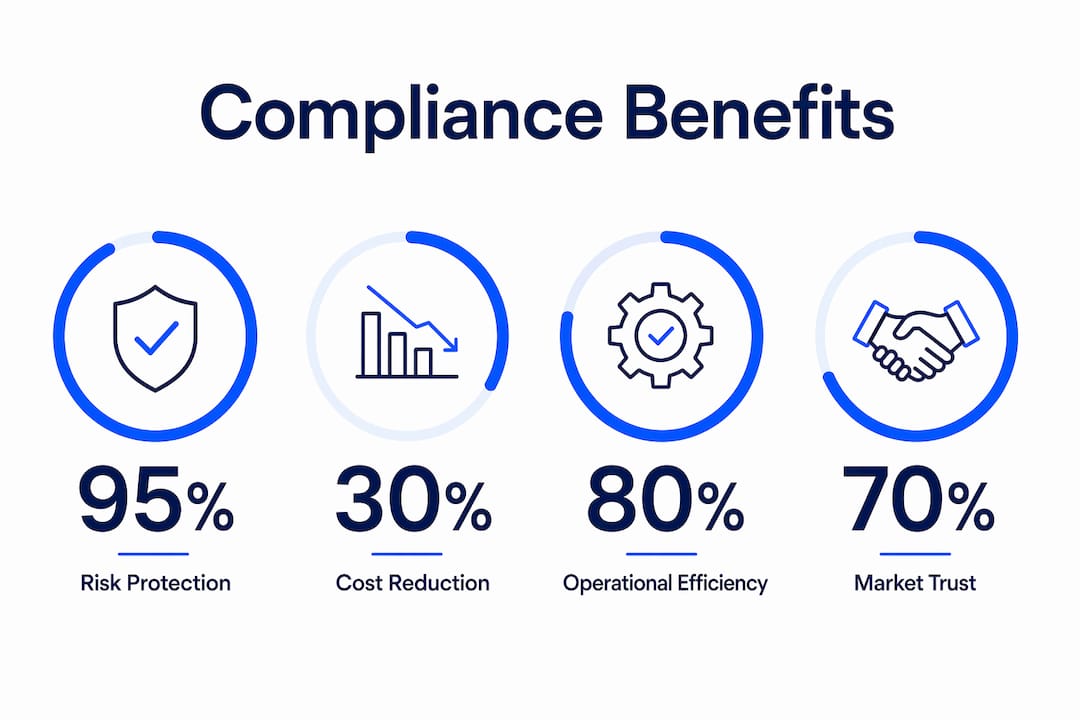
The key distinction is treating compliance as embedded infrastructure rather than a one-time setup. A compliance program that lives inside your payment and onboarding software runs continuously without adding headcount. One that exists only in a policy document requires constant manual intervention to stay current.
Pro Tip: When evaluating a financial services provider, ask specifically whether AML and transaction monitoring are automated at the platform level. If the answer is vague, the compliance burden shifts back to your team.
How does compliance build trust and open commercial doors?
Compliance functions as a competitive moat because it signals risk tolerance and institutional credibility to partners, investors, and enterprise buyers. Regulated firms build trust that differentiates them in markets where counterparty risk is a real concern.
Strong compliance reduces friction in due diligence, speeding enterprise sales and improving investor confidence by making your company easier to assess and approve. That is a direct commercial advantage. A buyer who can verify your controls in two days closes faster than one who needs six weeks of back-and-forth.
The commercial benefits realized by compliant firms include:
- Faster onboarding by enterprise clients who require vendor compliance certifications
- Shorter investor due diligence cycles because controls and reporting are already documented
- Easier access to regulated payment networks like SEPA and SWIFT, which require compliant account structures
- Reduced insurance premiums, as underwriters price compliance risk directly into coverage costs
- Stronger negotiating position with banking partners who assess counterparty compliance before extending credit facilities
Investing in compliance creates faster market entry and accelerates licensing approvals by removing the regulatory blockers that stall revenue. For e-commerce businesses expanding into the EU or cross-border markets, this is not a theoretical benefit. It is the difference between launching in Q1 and launching in Q3.
The importance of compliance in payments is especially pronounced for businesses processing high transaction volumes across multiple currencies. Regulated payment infrastructure gives you access to networks and settlement speeds that unregulated alternatives simply cannot offer.
What practical steps can SMEs take to build compliant financial operations?
Compliance does not happen by selecting the right provider once and moving on. The most successful SMEs embed automated controls for AML and transaction monitoring as part of their core financial services stack. The following steps give you a practical path to get there.
-
Choose a regulated financial services provider. Verify that your banking or payment provider holds a license from a recognized regulatory authority, such as the European Central Bank, the FCA, or an equivalent body. Regulation is not a marketing claim. It is a verifiable public record.
-
Integrate compliance into your payment and onboarding software. Compliance controls embedded in your payment flow catch issues at the point of transaction, not weeks later during a manual review. Look for providers that offer built-in KYC verification and automated AML screening.
-
Establish segregated accounts for client funds. If your business holds funds on behalf of customers, segregated accounts are a legal requirement under most EU frameworks and a practical protection for your clients.
-
Build a living compliance program, not a static policy document. Compliance programs must evolve continuously and align tightly with real operational processes. Schedule quarterly reviews of your AML policy, data handling procedures, and transaction monitoring thresholds.
-
Train your team on compliance as an operational function. Compliance failures most often originate in day-to-day decisions made by staff who do not understand the rules. Regular training sessions, with documented attendance, reduce both risk and personal liability for leadership.
-
Monitor regulatory updates in your operating markets. GDPR, PSD2, and AML directives update regularly. Subscribe to regulatory bulletins from the relevant authorities and assign a named owner for compliance updates inside your organization.
For e-commerce businesses operating across borders, the cross-border compliance checklist approach is the most practical starting point. It maps your payment flows against the regulatory requirements of each market you operate in, identifying gaps before they become enforcement actions.
Key Takeaways
Compliant financial services protect businesses from penalties, reduce operational costs through automation, and create measurable commercial advantages in enterprise sales and investor relationships.
| Point | Details |
|---|---|
| Risk protection is immediate | Regulated providers segregate client funds and automate AML checks, reducing fraud and insolvency exposure. |
| Compliance cuts operational costs | Automated transaction monitoring and reporting replace manual workflows, freeing staff for higher-value work. |
| Trust accelerates revenue | Well-documented compliance controls shorten due diligence cycles and speed enterprise and investor approvals. |
| Compliance must be dynamic | Static policy documents fail regulatory scrutiny; controls must be embedded in live operational workflows. |
| Provider choice is foundational | Selecting a licensed, regulated financial services provider is the single most impactful compliance decision an SME makes. |
Why I think compliance is the most underrated growth lever for SMEs
Most business owners treat compliance as a tax. They spend the minimum required to satisfy a regulator and move on. That framing costs them more than any fine ever would.
The firms I have seen grow fastest in regulated markets are the ones that treated compliance as a product feature. Their due diligence packages were clean. Their audit trails were ready on demand. When an enterprise buyer or institutional investor came calling, they closed in weeks while competitors were still assembling documentation.
There is also a cultural dimension that rarely gets discussed. A business that embeds compliance into its daily operations builds a team that thinks carefully about risk, data, and accountability. That culture compounds over time. It shows up in fewer errors, better vendor relationships, and a reputation that attracts the kind of partners who make long-term growth possible.
The fintech benefits for European SMEs that matter most are not the flashy ones. They are the quiet advantages that come from operating on regulated infrastructure: faster payments, cleaner audits, and the confidence to enter new markets without legal exposure slowing you down.
Compliance is not a checkbox. It is the operating system your business runs on. Build it right once, keep it current, and it pays dividends every time a new opportunity requires someone to trust you quickly.
— dd
Demivolt’s tools for compliant financial operations
Demivolt is built specifically for businesses that need compliant financial infrastructure without the complexity of traditional banking.
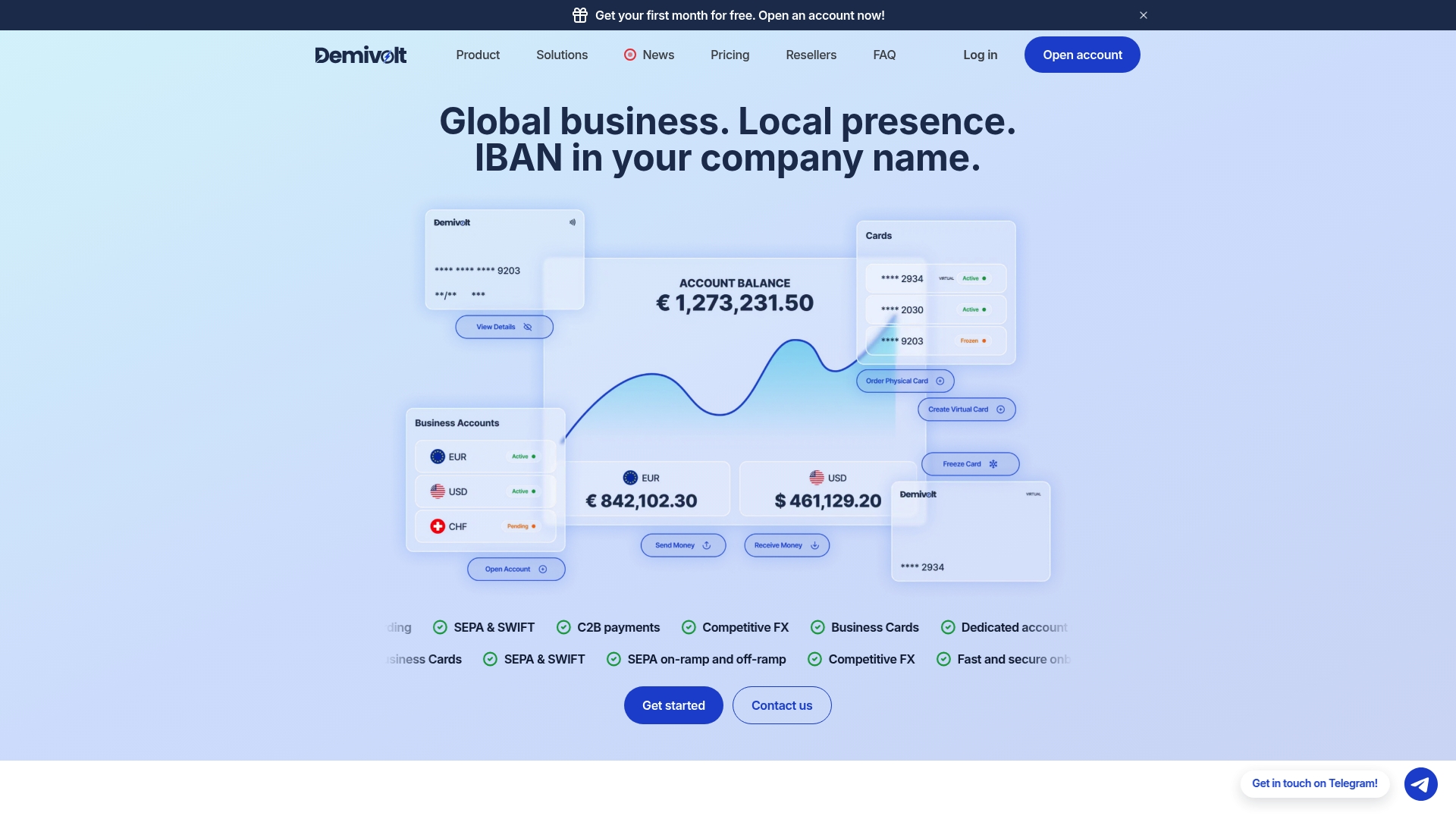
The platform’s IBAN Validator checks account numbers against the ISO 13616 standard in real time, catching errors before a payment fails or triggers a compliance flag. For businesses running SEPA transactions, Demivolt’s free SEPA tools support accurate, compliant payment processing across EU markets. Client funds are held in segregated accounts, meeting EU regulatory requirements from day one. If you are an SME or e-commerce business looking for compliant business banking that works across borders, Demivolt is worth a close look.
FAQ
What are the main benefits of compliant financial services?
Compliant financial services protect businesses from regulatory fines, segregate client funds for insolvency protection, and reduce fraud through automated AML controls. They also accelerate commercial relationships by making due diligence faster for investors and enterprise partners.
How does compliance reduce costs for SMEs?
Automated compliance systems replace manual transaction reviews and audit preparation, cutting staff hours and reducing the risk of costly errors. Firms that embed compliance into their payment and onboarding workflows report lower operational losses over time.
What happens if a business uses an unregulated financial provider?
Unregulated providers do not hold client funds in segregated accounts, meaning business owners become unsecured creditors if the provider fails. They also lack the AML and reporting infrastructure required by regulators, exposing the business to enforcement action.
How does compliance affect enterprise sales and investor relationships?
Strong compliance documentation reduces friction in due diligence, allowing enterprise buyers and investors to assess and approve your business faster. Well-documented controls and reporting are a direct commercial advantage in trust-sensitive markets.
What is the difference between a static compliance policy and a living compliance program?
A static policy document describes rules but does not enforce them in real time. A living compliance program embeds controls directly into operational workflows like payment processing and customer onboarding, catching issues as they occur rather than after the fact.
Recommended
- Demivolt | Blog – Financial Compliance Explained for SME Owners in 2026
- Demivolt | Blog – Modern business banking trends: boost efficiency & compliance
- Demivolt | Blog – International Payment Compliance Checklist for SMEs
- Demivolt | Blog – International payments for SMEs: efficiency, compliance, growth